Poker online: how to play poker, understand the rules and start today
Last updated: July 2025 · Reviewed by the editorial team at iGaming Bangladesh

Last updated: July 2025 · Reviewed by the editorial team at iGaming Bangladesh
"Over years of analysing digital entertainment we have learned one truth: understanding game mechanics must always come before a deposit. When building a strategy for a new audience we emphasise studying the rules, evaluating risks and variance — not promising quick wins." — Nadia Farzana Haque, Editor-in-Chief, iGaming Bangladesh.
3 key takeaways before you read further:
In the world of digital strategy games, poker online occupies a unique niche. Outcomes depend not only on probability distribution but also on mathematical analysis and psychological insight. Across South Asia — where audiences are accustomed to deep cricket analytics — card-based competitive formats demand a similar approach: cool-headed study of statistics and thorough understanding of the rules. Much like any sport, immersion begins with mastering fundamentals, acknowledging risks and choosing legitimate platforms.
Poker is a strategic card game of incomplete information. Victory is achieved either by assembling the best combination of cards or by using bets skillfully enough to force every opponent to fold. Unlike pure lotteries, long-run results here are shaped primarily by player skill. The online poker format attracts millions because it provides round-the-clock access to tables, lets you practise at micro-stakes and offers software tools for analysing your own play.
Worth pausing on that last point. The analytical layer — hand-history databases, equity calculators, HUD overlays — is what separates the poker game from most other card pastimes. You can literally review every decision you made, spot leaks and patch them before the next session. That feedback loop is why poker rewards study more than intuition.
"Poker engages executive functions — impulse control, working memory and strategic flexibility — which fundamentally distinguishes it from games of pure chance." — Impact of online poker gambling on behavioural and cognitive functioning, Journal of Behavioral Addictions, 2024. https://pubmed.ncbi.nlm.nih.gov/
The primary difference between the digital format and a brick-and-mortar casino is speed of play, remote access and automation of mechanical processes. Integration of a certified RNG (random number generator) eliminates the need for a human dealer to physically shuffle the deck. Industry reports indicate that online poker delivers roughly 120 hands per hour, whereas live play at a physical table yields only about 45 hands in the same period (data from Online Poker Statistics: Market Data Report, Gitnux — aggregated operator data).
That threefold increase in volume changes everything. More hands mean faster learning, but also faster losses if you are not prepared.
"Players cite convenience, 24/7 availability and the comfort of playing from home as the main advantages of online poker over land-based venues." — Internet Gambling in New Jersey, Rutgers School of Social Work, 2023–2024. https://www.rutgers.edu/
Beyond speed, the digital interface completely changes how you read opponents. Players are deprived of visual tells and body language. Instead, they rely on bet sizing, timing (how long an opponent takes to act) and hand-history records to estimate opponents' hand ranges. In a sense, playing poker online is closer to solving a math puzzle than reading faces.
Training formats with no financial buy-in (for fun) are ideal for absolute beginners who want to explore the interface safely. Regular play, on the other hand, requires a dedicated bankroll, readiness for emotional stress and a systematic approach to study. In our editorial experience, many users from the Bangladesh region initially rushed to jump into tournaments. We restructured the content on our portal by introducing knowledge-check checklists, after which the share of risky first deposits dropped and engagement with educational content rose measurably. This example confirms that the smartest way to start today is on play-money chips.
One more thing: free poker is not just for people who are afraid to spend money. It is a diagnostic tool. You discover whether you actually enjoy the decision-making process — or whether you are simply chasing the adrenaline of a wager. That distinction matters more than most guides admit.
The fundamental goal of any poker hand is to win the accumulated pot. You can do this in two ways: show the strongest combination of cards at showdown, or force every opponent to fold through aggressive betting. The rules enforce a strict sequence of actions — bets proceed clockwise, and each participant makes tactical decisions based on the strength of their own cards and the potential actions of their opponents.
Simple enough on paper. In practice, the interplay between position, stack depth and opponent tendencies turns each hand into a small strategic puzzle.
"In Texas Hold'em each player receives two private cards; then five community cards are revealed in stages, and the best five-card combination wins the pot." — Rules of Hold'Em Poker for Computers (and people too!), Ferguson, Carnegie Mellon University. https://www.cs.cmu.edu/
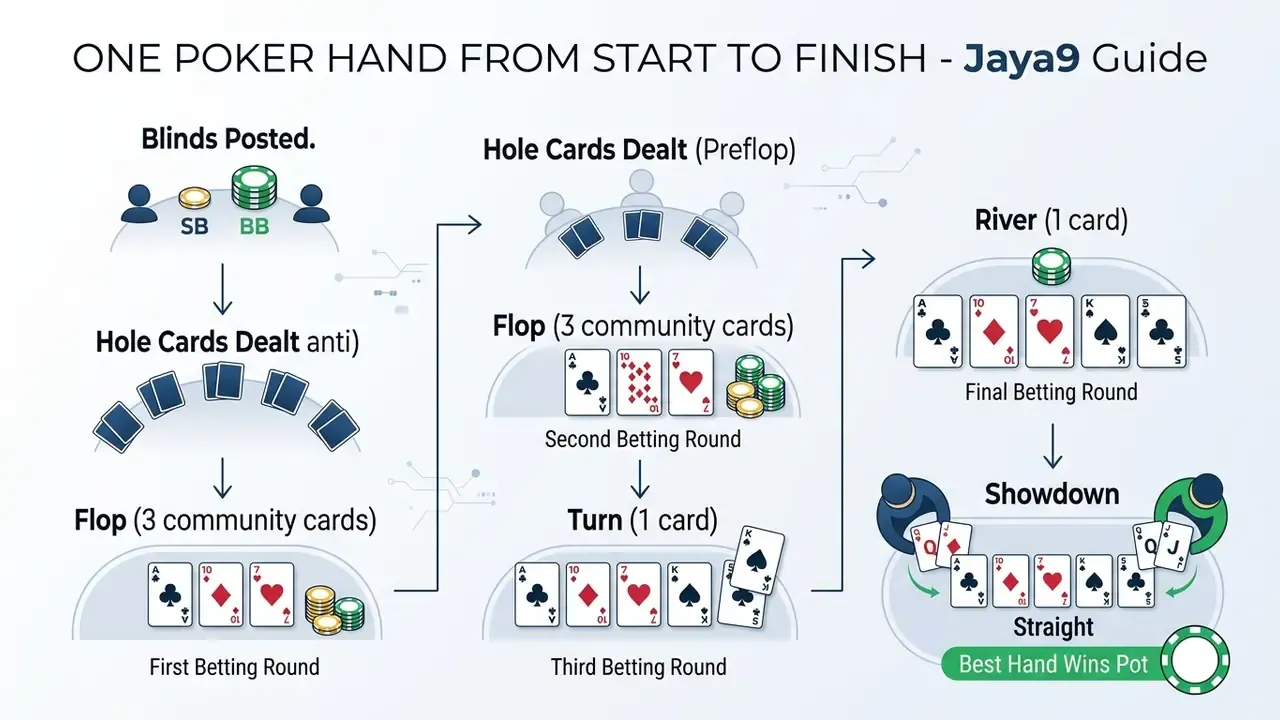
A standard hand is divided into clear stages: preflop, flop, turn, river and showdown. At preflop, participants receive their hole cards and evaluate their potential before any community cards appear. On the flop the dealer reveals three community cards, triggering a new betting round. The turn and river each add one more community card. If two or more players remain after the river, showdown occurs — participants reveal their combinations and the pot is awarded to the holder of the best poker hand.
Each stage narrows the range of possibilities. Preflop is wide open; by the river, you should have a fairly clear picture of where you stand. Or at least, that is the goal.
These terms describe the basic toolkit for interacting with the game. The table is the zone where players gather and community cards are placed. Chips are the universal game currency; online, your chip count updates automatically. A bet is a decision to put chips into the pot, signalling confidence in your cards. A fold is discarding your cards — a defensive mechanism that lets you avoid further losses when the situation at the table is not in your favour.
Beginner tactic tip: If the flop shows three cards of the same suit and you hold no flush draw, a fold is usually the safest play. Conversely, if you have assembled a strong combination — say, top pair with a good kicker — consider a raise to put pressure on opponents who may be drawing thin. Learning when to fold and when to raise is genuinely more valuable than memorising obscure combinations.
Here is a small observation from reviewing thousands of beginner hand histories: the single most common mistake is not folding too much. It is folding too little. New players call with marginal hands because folding feels like quitting. It is not. Folding is a strategic weapon.
The hand-rankings hierarchy is a mathematically grounded table of seniority. The difficulty of assembling a combination determines its power. Card strength is evaluated by the best five-card grouping from all available cards, and every player must apply the classic scale — from the highest (Royal Flush) down to the weakest (High Card). Knowing these rankings is the foundation of poker rules; without them, making informed decisions is impossible.
Think of it this way: you would not step onto a cricket pitch without knowing how runs are scored. Hand rankings serve the same purpose in poker.
When the main combinations are identical, the winner is determined by the kicker — the highest-ranking unpaired card. If two players share the same main hand (for example, both hold a pair of aces), the pot goes to the player whose additional card ranks higher. If all five evaluated cards match completely, the pot is split evenly.
"Players systematically overestimate weak draws and underestimate their win probability with strong hands — a pattern consistent with cumulative prospect theory." — The Sub-proportionality of Subjective Probability Weighting in Poker, Duke University, 2024. https://duke.edu/
Understanding this cognitive bias is practical: beginners often chase unlikely draws while failing to extract full value from premium hands. Awareness of probability weighting errors helps you make calmer, more mathematically sound decisions. In other words, the biggest edge at low stakes is not a fancy bluff — it is simply valuing your strong cards correctly.
Hand rankings in classic poker (strongest to weakest)
| Rank | Name | Card description |
|---|---|---|
| 1 (Strongest) | Royal Flush | Ten, Jack, Queen, King and Ace of the same suit. |
| 2 | Straight Flush | Five consecutive cards of the same suit (e.g. 5-6-7-8-9 of hearts). |
| 3 | Four of a Kind | Four cards of the same rank (e.g. four eights). |
| 4 | Full House | Three of one rank plus a pair (e.g. three kings and two twos). |
| 5 | Flush | Any five cards of the same suit, order irrelevant. |
| 6 | Straight | Five consecutive cards of mixed suits. |
| 7 | Three of a Kind | Three cards of the same rank. |
| 8 | Two Pair | Two pairs of different ranks. |
| 9 | One Pair | One pair of cards of the same rank. |
| 10 (Weakest) | High Card | No combination formed. The highest individual card plays. |
Texas Hold'em is recognised as the global standard of poker and the primary entry point for newcomers, thanks to an ideal balance of accessible rules and deep strategy. According to industry data, Texas Hold'em is preferred by roughly 82% of surveyed online players, and 6-max No-Limit Hold'em formats account for over 55% of global cash-game traffic (Online Poker Statistics: Market Data Report, Gitnux. https://gitnux.org/). This is the variant broadcast on sports media, and over 90% of educational poker content online is written specifically for it.
The ease of learning stems from shared community cards. Rather than tracking numerous open and hidden cards belonging to each opponent (as in Seven-Card Stud), in Hold'em you monitor five board cards that are common to every player at the table. You control only two personal cards, which drastically lowers cognitive load and lets you grasp the game's mathematics faster.
"In Hold'em, five community cards are visible to all participants, which significantly reduces the complexity of tracking information compared with closed-card games." — Rules of Hold'Em Poker for Computers (and people too!), Ferguson, CMU. https://www.cs.cmu.edu/
There is also a practical advantage: because Texas Holdem dominates the market, you will never struggle to find a table. At any hour — morning in Dhaka or midnight in London — there are cash games and tournaments running. That availability alone makes it the logical starting point.
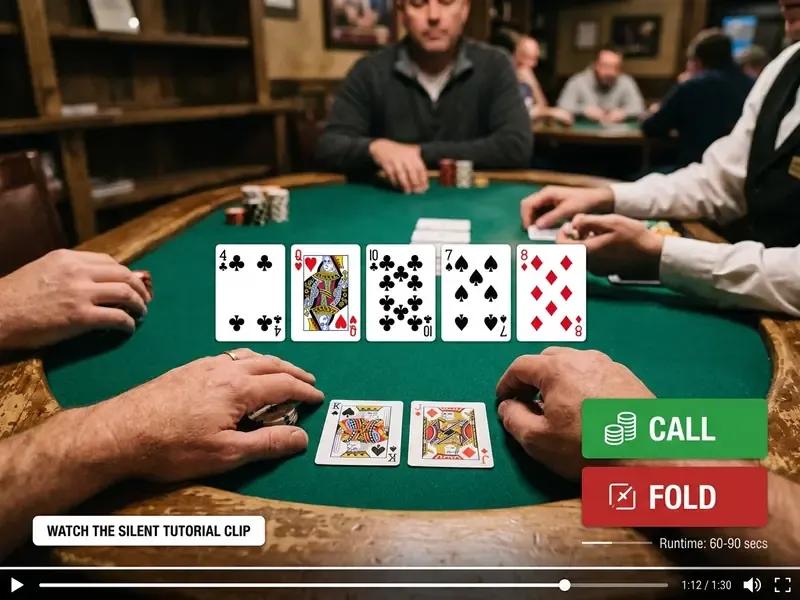
In your first session at a virtual table, focus not only on your pocket cards but also on board texture: are flush or straight draws forming? Pay close attention to the dynamics of betting. If an opponent suddenly raises big on an innocuous-looking flop, a beginner should learn to apply fold rather than trying to outplay the mathematics on pure emotion.
Actually, let me rephrase that. Do not just "pay attention" — actively narrate the hand to yourself. Say it internally: "The flop is King-Nine-Four, two spades. I have no spade. If someone bets big, they might have a flush draw or top pair." That internal commentary builds pattern recognition faster than passive observation.
Post-flop attention checklist for beginners:
Modern licensed platforms offer dozens of poker variants, catering both to conservative strategists and fans of high-speed action. Beyond traditional Texas Hold'em, online players have access to Omaha, Five-Card Draw, Seven-Card Stud and specialised turbo tournaments that radically alter reward structures. The breadth of poker games available today means there is genuinely something for every temperament.
In Omaha each player receives four private hole cards instead of two. However, you must use exactly two of them combined with exactly three community cards to form your best five-card hand. This compulsory rule is what makes Omaha strategically richer — and trickier for newcomers. The increased number of hole-card combinations raises the average hand strength at showdown, meaning bluffs succeed less often and solid post-flop reading is essential.
Omaha is commonly played in Pot-Limit format (PLO), where the maximum bet equals the current pot. A "Hi/Lo" variant also exists, in which the pot can be split between the highest and the lowest qualifying hand — adding another layer of decision-making. If Hold'em feels too straightforward after a few months, Omaha is the natural next step.
Five-Card Draw is the format many people picture when they think of "old-school poker". Each player is dealt five face-down cards and may exchange some or all of them for new ones in a single draw round. With no community cards and no exposed information, reading opponents relies almost entirely on betting patterns and the number of cards they choose to swap.
While less common in modern online rooms than Hold'em or Omaha, Five-Card Draw remains available on several major platforms. It is an excellent way to practise hand-ranking recall in a simplified environment. There is something refreshing about its directness — no board to analyse, just your five cards and your nerve.
Cash games and multi-table tournaments (MTTs) are classic formats where rewards correlate with prolonged, consistent application of skill. In contrast, fun formats — such as jackpot Sit-and-Go (Spins) — feature high variance. They attract thrill-seekers because a random multiplier can dramatically inflate the prize pool before a single card is dealt.
"Players disproportionately choose formats with rare large payouts, even when their expected value is lower than less volatile alternatives." — Skewness preferences: Evidence from online poker, Journal of Economic Behavior & Organization, 2024. https://www.sciencedirect.com/
For systematic learning, high-variance formats are less suitable. Ultra-short stacks and aggressive all-in dynamics obscure strategic nuance. Think of it this way: you would not learn batting technique in a T10 match. Start with the longer format, build your fundamentals, then experiment.

Public tables are open to any registered player, providing instant opponent matching from around the globe. Private rooms are protected by a password or invite code. This format is ideal for organising home-game-style tournaments digitally, where competitive pressure is lower and the focus shifts to social interaction rather than financial stakes.
In private clubs you can customise blind speeds, starting stacks and even game duration — recreating the atmosphere of a kitchen-table game with friends, no matter the distance. For players in Bangladesh and across South Asia, where gathering physically for a poker night may not always be practical, private online rooms fill a genuine social gap.
A secure start requires following a structured algorithm: verify the platform's legality, study the room's internal rules, practise on play money and protect your personal data through KYC procedures. Mistakes begin when users skip the theory stage and jump to real-money stakes, driven by excitement.
Before sitting at a real-money table, review local legislation and confirm that the platform holds a valid licence. Common regulators include the Malta Gaming Authority, Curaçao eGaming and the UK Gambling Commission. In the lobby, check table limits, rake structure and the reliability of deposit and withdrawal methods. Read the platform's terms of service — violating fair-play rules can lead to account suspension.
Platform checklist for players in South Asia:
Practising on free poker completely eliminates financial risk during the learning phase. You train yourself to recognise hand rankings automatically and internalise the order of play. But — and this is important — free play is not without its own traps.
"Among those who combine play-money and real-money gambling, problem gambling is detected in 33% of cases compared with 7% among those who gamble only for real money." — Simulated Gambling: An Explorative Study Based on a Representative Survey, Fiedler et al., 2023. https://pubmed.ncbi.nlm.nih.gov/
"Simulated gambling typically precedes real-money wagering chronologically and is associated with higher harm scores on the PGSI scale." — Order of first-play in simulated versus monetary gambling, Journal of Behavioral Addictions, 2024. https://pubmed.ncbi.nlm.nih.gov/
These findings highlight a nuanced reality: free play is a valuable learning tool, but transitioning to real money demands strict self-discipline. Play-money chips can encourage a careless attitude — calling every hand, chasing every draw — that becomes expensive the moment real stakes are involved. Be aware of that shift.
No honest poker guide is complete without a dedicated discussion of risks. Poker's strategic depth does not eliminate the possibility of sustained losing streaks caused by variance. And the transition from play-money to real-money tables is precisely where many beginners run into trouble.
Variance is the natural statistical swing in short-term results. Even a highly skilled player can experience prolonged downswings purely due to card distribution. Professional players manage this through bankroll management — never risking more than a small percentage of their total funds at any single table or tournament.
A common guideline for cash games is to have at least 20–30 buy-ins for the stake you play. So if you are playing at a table where the buy-in is 500 taka, you should have 10,000–15,000 taka set aside exclusively for poker. That buffer absorbs the inevitable swings without forcing you to reload under emotional pressure.
"Players cite the ease of online spending and the perception of greater addictiveness as the main perceived disadvantages of the digital format." — Internet Gambling in New Jersey, Rutgers School of Social Work. https://www.rutgers.edu/
If you notice yourself chasing losses, playing longer than planned or feeling irritable after sessions, these are early warning signs. Do not dismiss them. Most regulated platforms offer built-in tools — deposit limits, session timers, cooling-off periods and self-exclusion options. Use them proactively, not as a last resort.
Key responsible-gaming practices:
Honestly, the best players we have spoken to treat these limits the same way athletes treat recovery days. It is not weakness. It is part of the discipline.
The quality of user experience is determined by mobile accessibility, lobby transparency, speed of seating and the existence of an ecosystem for reviewing your own mistakes. The current industry standard eliminates the need to download heavy desktop clients, optimising the interface for HTML5 browsers and smartphones.
A modern client must be mobile-responsive and offer instant-play functionality. Lobby sorting with clear display of limits, online player counts and game type directly affects how quickly you can start. If the interface forces unnecessary clicks to find micro-stakes tables, frustration rises — and beginners leave before they even play a hand.
Look for platforms where the path from login to seated-at-table takes under 60 seconds. That may sound like a minor detail, but it shapes your entire relationship with the poker game over time.
Even without a live dealer, online poker generates a genuine competitive atmosphere through built-in replayers (hand history). This feature lets you export a played hand, discuss it with fellow enthusiasts on online poker platforms or load it into database software for analysis.
"Professional players regularly use hand-history databases and HUD tools to identify weaknesses and adjust strategy." — Gambling as Work: A Study of German Poker Players, Journal of Gambling Studies, 2023. https://pubmed.ncbi.nlm.nih.gov/
Transparency of past results and the presence of an active community compensate for the absence of face-to-face emotions. They help players analyse tactics from a sporting perspective — treating each session as a training ground rather than a gamble.
- Myth: Poker is just luck.
- Fact: An econometric analysis of over 85 million hands found that skill begins to statistically dominate chance at sample sizes of 1,500 hands and above; over the long run, mathematical knowledge and psychological composure are the decisive profit factors. — Hergueux & Smagghue, reviewed in Talberg & Newall policy brief, 2025. https://pubmed.ncbi.nlm.nih.gov/
- Myth: Only cowards play free poker.
- Fact: Familiarising yourself with the software through training tables reduces the chance of a costly technical error (misclick) for an estimated 80% of beginners. There is nothing cowardly about preparation.
- Myth: You should play every format from day one.
- Fact: Texas Hold'em remains the recommended foundation because of its simplified board and the enormous library of freely available strategies. Master one format before branching out.
- Myth: Online poker is rigged.
- Fact: Licensed platforms use independently audited RNG systems. Certification bodies like eCOGRA and iTech Labs test millions of hands for statistical fairness. Perceived "bad beats" are a natural consequence of playing far more hands per hour than you would in a live setting — variance becomes more visible, not more frequent.
Yes, you can begin with free applications, but complete ignorance of poker rules will turn the process into random button-clicking. Practice on free poker is effective only when combined with reading theory — when you consciously try to understand *why* the software awarded the pot to a particular player. A practical approach: play ten hands, then pause and review what happened. Did you understand the winning combination each time? If not, revisit the hand-rankings table above. That cycle of play-review-learn is what makes free poker genuinely useful rather than just a time-filler.
Absolutely start with Texas Hold'em. Its mechanic of two private cards and five community cards serves as the template for the vast majority of tutorials, odds calculators and tournament strategies. Omaha (where you receive four private cards) or Stud require a deeper understanding of probabilities that is best trained in a simpler environment first. Once Hold'em logic is second nature, branching out to other poker games becomes far more intuitive. You can [start playing poker online](https://jaya9-appbd.com) on a reputable platform whenever you feel ready — just make sure you have spent enough time on play-money tables first.
For comfortable button-clicking without interface confusion, you need one to two hours and a couple of hundred hands. However, reaching a level where skill consistently outweighs variance takes considerably longer.
Seven months might sound daunting. It is not, really. Think of it as learning any competitive skill — chess, cricket strategy, a musical instrument. The early weeks are the steepest part of the curve, and progress feels tangible almost immediately. Approach the game responsibly: treat it as a hobby, control your time and budget, and measure progress in months rather than days.
Disclaimer: Poker for real money involves financial risk. Set time and budget limits before you begin playing. The information above is for educational purposes and does not constitute financial or legal advice. If you or someone you know is struggling with gambling, reach out to a professional support service.